My blog has moved!

You will be automatically redirected to the new address. If that does not occur, visit
http://teaandpolitics.wordpress.com/
and update your bookmarks.

Showing posts with label Philippines. Show all posts

Friday, 22 October 2010

Philippines: bomb on bus kills 10, wound 9

That is the final toll.Although no one has claimed responsibility, police believes the responsible of the attack are members of gang linked to Muslim terrorists from the South, called Al-Khobar.
A bomb ripped through a passenger bus Thursday in the southern Philippines, killing at least eight people and wounding 10 in an attack authorities blamed on an extortion gang with links to Muslim militants.

The bus was traveling with more than 50 passengers when the powerful blast shook the rear part of the vehicle from the overhead compartment, police Chief Superintendent Gil Meneses said. The force of the blast was so strong it decapitated two of the victims, he said.

The wounded were brought to hospitals near Matalam township in North Cotabato province. Police and army units interviewed survivors and combed through the twisted metal trying to extract the injured, Meneses said.

No one immediately claimed responsibility for the bombing. The south of the Philippines is home to kidnappers, extortion gangs and a decades-old Muslim insurgency.

Military spokesman Lt. Col. Randolph Cabangbang said authorities suspect the Al-Khobar extortion gang in the attack, saying the bus company involved in the bombing had been targeted for extortion in the past.

Al-Khobar is the most notorious of the region's extortion gangs, and authorities say it is made up of criminals and former Muslim rebels who have been blamed for attacking business establishments refusing to pay their ransom demands. The group is on a U.S. list of terrorist organizations.
Source.

For more information on Al-Khobar's activity, click here.

Tuesday, 12 October 2010

Philippines: Supreme Court rules anti-terrorism law constitutional

The Supreme Court has upheld the constitutionality of a 2007 anti-terror law, which the government sought to bolster a U.S.-backed campaign against al-Qaida-linked militants but critics fear could muzzle civil liberties.
Left-wing alliance Bayan, one of the groups that sought the repeal of the Human Security Act, said Monday it would appeal last Friday's ruling. The law rarely has been used since it took effect because law enforcers fear the heavy punishment it includes for mistaken arrests and abuses.
Then-President Gloria Macapagal Arroyo, a staunch Asian ally of the U.S. campaign against terrorism, signed the anti-terror law in 2007 to turn her Southeast Asian country — regarded as a breeding ground of Islamic radicals — into a hostile territory for militants.
Arroyo cited terrorist attacks, including the bombing of buses, telecommunications and power lines.
The United States and Australia welcomed the new law, which took effect in July 2007. U.S. and Australian security officials have expressed fears that suspected terror training camps in the southern Philippines could produce militants who could strike anywhere in the world.
But several left-wing groups, legislators and human rights advocates separately petitioned the Supreme Court to declare the law unconstitutional, arguing its definition of terrorism was too broad and could cover legitimate dissent like labor strikes, anti-U.S. demonstrations and even daring stunts by Greenpeace activists who barge into ships and power plants.
The law defines terrorism as any of at least 12 violent crimes — including murder, kidnapping, arson, piracy, coup and rebellion — that cause widespread and extraordinary panic and force the government to give in to an unlawful demand.
Source.

Wednesday, 6 October 2010

Philippines: Terrorist group discovered "following the money"

Follow the Money | Maria Ressa's Blog Site:
The name of this just discovered group is Al Intlaqah, which Philippine intelligence reports say means “the beginning” or “take-off.” Allegedly based in Saudi Arabia, authorities say it is affiliated with Al-Qaeda. Interestingly enough, it uses the same networks Al-Qaeda exploited in the Philippines in the past.

The discovery began last February after the Philippine National Police arrested two Jordanian nationals Khalil Hassan Al-Ali and Walid Abu Aishe. Their interrogation led to another arrest two weeks ago of Jordanian Mohammed Amro Amayin. These three men have been long-time residents of the Philippines. They have businesses like a recruitment agency and a restaurant.

So they seem to be what spies would call “sleepers.” They built lives in Manila – they married locally and are raising their families in the Philippines. They have also been linked by authorities to the 1995 cell used by World Trade Center bomber Ramzi Yousef and his uncle, Khalid Shaikh Mohammed, the architect of 9/11.

Monday, 20 September 2010

Philippines: Abu Sayyaf terrorist killed by troops

WaPo:
Philippine troops clashed with Abu Sayyaf gunmen in a southern coastal village Sunday and killed a long-wanted militant who helped in the 2001 kidnapping of three American and 17 Filipino tourists and the takeover of a hospital, the military said.
Abdukarim Sali was killed before dawn in a clash with troops and police in Lower Mangas village on Basilan island's Lantawan township - a stronghold of the al-Qaida-linked Abu Sayyaf, regional military commander Lt. Gen. Benjamin Dolorfino said.
The other militants fled, leaving behind Sali's body, an M16 rifle and grenade launcher, ammunition and cell phones.
The government offered a $7,700 bounty for the capture or death of Sali, who has been accused of helping kidnap three American and 17 mostly Chinese Filipino tourists in May 2001 from the Dos Palmas resort in western Palawan province.

Friday, 16 April 2010

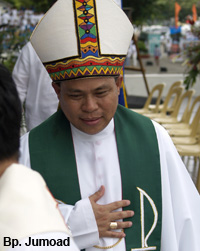
Philippines: Bishop fears for Christians' lifes after Basilan's attacks

Basilan's religion profile Category: BasilanImage via Wikipedia
This is an update on this story:
Following an April 13 Islamist terrorist attack that destroyed 70% of his cathedral, a Philippine bishop says that he and the other Christians of the city fear for their lives.
“It is the first time we are attacked so directly and with such force,” said Bishop Martin Jumoad of the Territorial Prelature of Isabella. “In the past, I received several threatening letters and intimidation. There have been other smaller attacks, but now it is very different. This could be a tragedy. I seriously fear for my life and the lives of the faithful.”
“I have prepared a pastoral letter calling on Catholics to stay in Basilan, which is our home, and asking them to remain calm, not to react to violence, and to pray for peace,” he added. “Today, a procession of people carrying candles as a sign of peace lit the city. Our hope must not die.”
81% of the Philippines’ 88.7 million people are Catholic. However, the territory in which Bishop Jumoad ministers is predominantly Muslim, with only 27% of residents being Catholic.
CNA has more on the Bishop's statements:
Sta. Isabel Cathedral via.
The 53-year-old prelate said he does not know how to rebuild the cathedral (left), constructed in 1970 with a capacity for 1,400 worshipers.
...The blasts shattered the cathedral’s stained glass windows and damaged the priests’ rectory. Several priests’ service vehicles were also destroyed.
Regional military chief Lieutenant General Ben Dolorfino said military intelligence had received reports of an impending attack, but not its details, AFP says.
"They were planning something big. This was well planned and apparently they were well funded."
Authorities suspect that politicians who hired mercenaries may have been behind the attacks. 
LWJ reports on other aspects of the attacks:
Five civilians, five Philippine Marines, a policeman, and four Abu Sayyaf Group fighters were reported killed in the ensuing clashes, and five Abu Sayyaf fighters were captured. Police and Philippine troops are currently pursuing the remaining Abu Sayyaf fighters.
Today’s attacks in Isabela are reminiscent of recent terror assaults by the Taliban, Lashkar-e-Taiba, and other al Qaeda-associated groups in Pakistan, Afghanistan, India, and Yemen.
A reasonable cause to attack his Cathedral, isn't it?

Reblog this post [with Zemanta]

Monday, 6 July 2009

Philippines: JI behind bombing outside Cathedral?

This is an update on this story: Philippines probes foreign angle in church blast - Yahoo! Singapore News
Major Randolph Cabangbang said investigators were probing whether Jemaah Islamiyah (JI), the group behind the Bali bombings, may have been involved in the blast outside the Immaculate Conception Roman Catholic cathedral.

He told reporters a number of JI militants are "here in the country."

Known members of the group Dulmatin, Umar Patek, and Zulkifli bin Hir are thought to be operating in the southern Philippines, he said, but added that there was no proof as yet they were involved.
If they didn't have enough with the MILF now they have also terrorists belonging to JI. This is not the first time a Cathedral is bombed in the Philippines and JI the main suspect. Last year, the Immaculate Conception Cathedral from Zamboanga was also bombed, with no casualties though:

Police have been placed on the highest level of security following the dawn explosions in Zamboanga city, regional police Chief Superintendent Jaime Caringal said. Government troops and police had already tightened security in the town for a weeklong national sports festival and a medical conference, he said.

Zamboanga, about 860 kilometers (530 miles) south of Manila, is home to U.S. troops providing counterterrorism training to Filipino soldiers. The military says the region is home to more than 300 armed members of the al-Qada-linked Abu Sayyaf (aka JI) terror group.

Tags Technorati: , , , , , ,

Sunday, 5 July 2009

Philippines: bomb blast outside Cathedral kills at least 5 people

Islamist militants have been blamed for a bomb blast in the Philippines today which killed at least five people and wounded dozens more.
The bomb exploded outside the Immaculate Conception cathedral in Cotabato city, 545 miles (880 kilometers) south of Manila, as church-goers celebrated Mass.
A woman selling roast pork was killed on the spot while four others, including a soldier and three-year-old boy, died in a nearby hospital. Among the wounded were five soldiers who were passing the cathedral in an army van when the device, fashioned from a mortar round, exploded said army spokesman Colonel Jonathan Ponce.
"This is the handiwork of the rogue members of the Moro Islamic Liberation Front (MILF)," Colonel Ponce told reporters, referring to the Muslim organisation which has waged a decades long battle for self rule in the southern island of Mindanao.
Times.

BBC doubts about the authors of the blast:
The military immediately blamed the attack in the town of Cotabato, Mindanao, on a militant group, the Moro Islamic Liberation Front.
The group has been fighting to establish a separate Islamic state.
One of its leaders denied any involvement in the attack, saying there was no religious conflict in the south.
Well, there is no other terrorist conflict in Philippines. Specially there are no other people (to my knowledge) who could set off a bomb in the entrance of a cathedral when the mass has finished and the people are just going out. It shows a real interest on killing believers in other religions.

AJ reports there are 45 people wounded. And that:
Nearly 600 people have been killed since then (end of talks with MILF), many of whom were civilians.
Fighting around the marshlands on central Mindanao has escalated in the last eight weeks, forcing more than 350,000 people to flee their homes and farms, pushing back any chance of resuming the peace talks.